
Norton Shores Directory Collections
Norton Shores did not become a city until 1968, so historical searches often begin with Muskegon or Norton Township rather than the modern municipal name. The Hackley Library Torrent House reports a complete known run of Muskegon city directories, while also warning by implication that no item-by-item annual inventory is published online. Recent volumes are kept at the main building and older material is at the Torrent House. Ask staff a narrow question, such as a surname plus a year range, rather than assuming a particular volume is available.
| Collection | Years | Where Held | Access |
|---|---|---|---|
| Muskegon city directories | Earliest known volume, 1873 | Hackley Library collection | Confirm the needed volume with staff |
| R. L. Polk directories | Selected 1883-1913, 1921, and selected 1951-1960 | Recent volumes at the main building; older volumes at Torrent House | In-library research |
| Later cited directory years | References to 1965 and 1970 | Hackley Library collection | Availability may vary by year |
| Muskegon digital directory set | 1887 and 1889 | Ancestry collection 5220 | Online collection, subject to its access terms |
These are documented run points, not a promise of an unbroken annual series. A missing year can reflect a gap in publication, preservation, cataloging, or the library's present shelf arrangement. The Library of Michigan city-directory guide is useful for understanding the several ways a volume can be organized, including surname, street, and telephone approaches.
Library access is a separate channel from an online index. Bring a short list of variant spellings, the likely years, and any old street form. The Torrent House has local databases and in-library sources in addition to its shelf material. That makes it a useful fallback when a digital search returns nothing or when a visible scan needs to be compared with the printed volume.
Norton Shores Directory Gaps
Directory coverage follows the life of a publication, not a modern city boundary. An 1873 book may be the earliest known Muskegon city directory, but it does not prove that every Norton Township household appeared in that volume. Likewise, the selected Polk runs leave years between documented points. Record the exact title page date and publisher before drawing a conclusion. That small habit prevents a common mistake: turning one unlocated name into proof that a person never lived in the area.
Use place names as search terms, too. Before the 1968 charter, an address or household connected with today's Norton Shores may be filed under Norton Township or described through Muskegon. Street names can help bridge that change, but the surrounding municipality printed in the book remains important context.
Note: A directory absence is a research lead, not a final finding about a household.
Norton Shores Torrent House
The Torrent House at 315 W. Webster in Muskegon is Hackley Library's local-history and genealogy setting. Its stated hours are Tuesday through Saturday, 9 a.m. to 5 p.m., and its phone number is 231-722-8016. Local databases and in-library sources are part of the service. Staff can help more effectively when a request names the person, approximate year, and whether the goal is a surname listing or an address trail.
The Torrent House research-sources page shows the kind of local-history access available there.
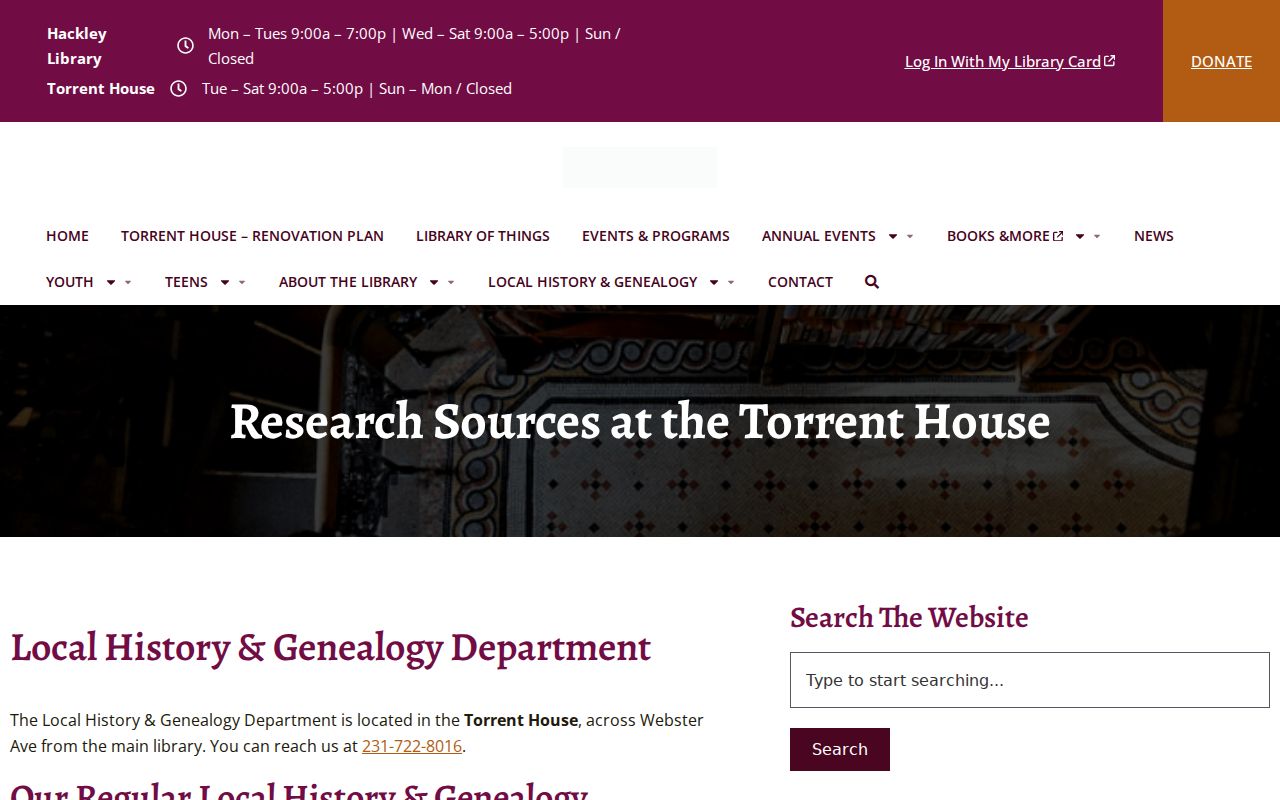
For a Norton Shores directory question, the image underscores why a library visit can supplement a name search with shelf-held and staff-assisted material.
Reading Norton Shores Directory Entries
A historical entry is not a standardized modern form. Depending on the volume, it can show a name, a spouse in parentheses, an occupation line, and a street address. Some editions add an ownership, tenure, or widow notation. None of those elements should be imagined when they are not printed. No verified Norton Shores entry was captured, so the record inventory stops at documented field types.
| Name | Usually the indexed person or household head, with spelling as printed. |
|---|---|
| Spouse clue | Some volumes place a spouse's given name in parentheses. |
| Work line | An occupation line may appear. |
| Address | The street and house number as used in that edition. |
| Status marks | Ownership, tenure, widow, and similar marks depend on the year's practice. |
Start at the front matter. The abbreviation key changes by publisher and edition, so a mark must be read from the volume that uses it. A surname page may list the home address while a reverse section can begin with the address. The digitized Muskegon R. L. Polk collection indexes more than 30,600 names and includes addresses and occupations for its 1887 and 1889 books, chiefly for heads of household.
Norton Shores Directory Entry Terms
Later books can present more than one path to the same address. That helps when a person is known by street but not by name, or when a surname spelling is uncertain. The labels below describe common directory tools, not features guaranteed in every Muskegon volume.
- Criss-cross directory
- A reverse arrangement that generally groups listings by street and house number, allowing an address-to-name search where the volume includes it.
- Householder index
- A listing organized around the principal household name, rather than every person who may have lived there.
- Abbreviation key
- The publisher's explanation of shortened words and symbols, usually printed in the opening pages of that particular volume.
Copy the title page and the key along with the listing. Those details preserve the edition, publisher, and meaning of the symbols when the result is later compared with a census, deed, or notice.
Norton Shores Microfilm Companions
Directories gain value when they are checked against records that answer a different question. Hackley Library's genealogy highlights describe microfilm resources that include birth indexes for 1867-1949, death indexes for 1867-1965, marriage indexes for 1867-1949, deed indexes for 1838-1887, deed records for 1838-1928, and declared naturalization records. Each set has its own access and coverage limits, so the range should be checked before relying on it.
The Hackley genealogy collection highlights identify those historical records and their formats.
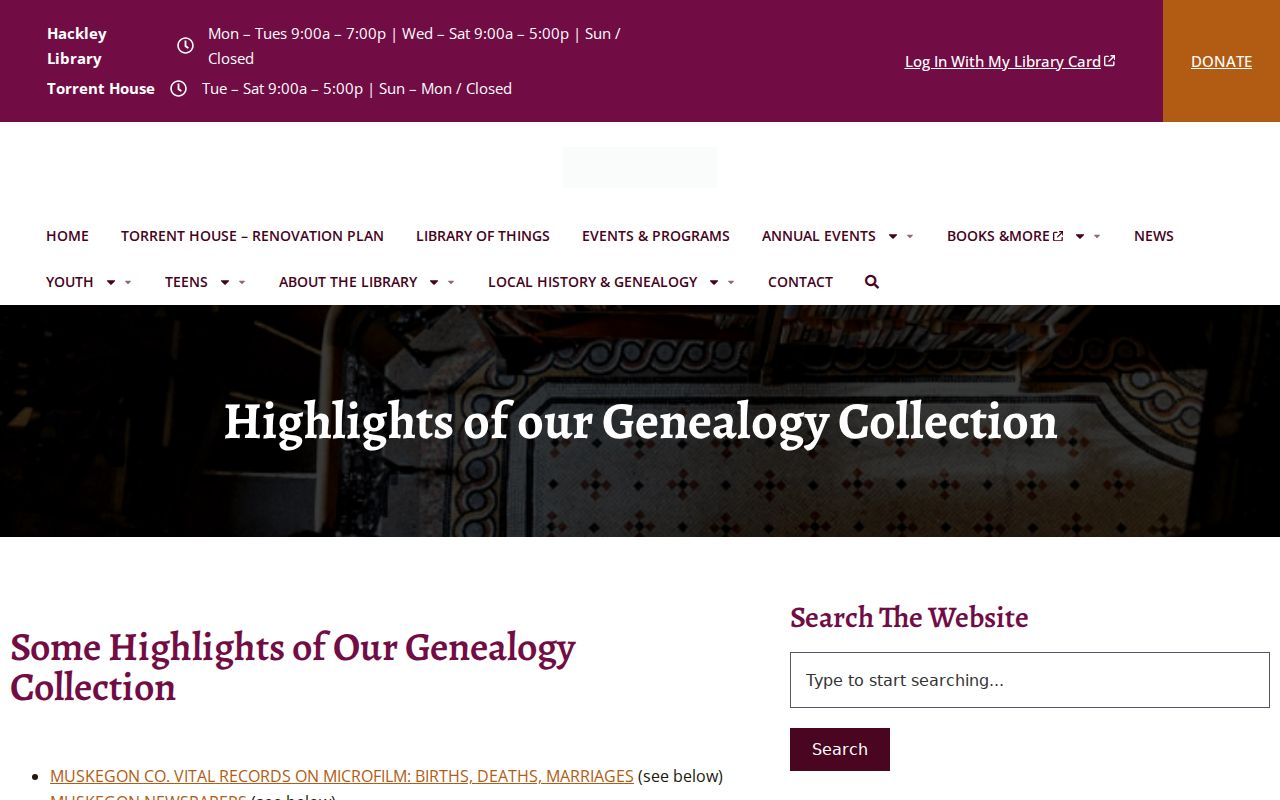
A directory address paired with an indexed life event or deed reference can turn a brief listing into a better documented family-history trail.
Norton Shores Directory Timeline
The known chronology is useful for setting expectations. It is not a complete publication history, and it should not be treated as one.
- 1873: The earliest known Muskegon city directory is credited to A. Bailey.
- 1883-1913: Selected R. L. Polk volumes are documented in the local collection.
- 1921: A further Polk run point is documented.
- 1951-1960: Selected Polk volumes are documented, with references also to 1965 and 1970.
- 1968: Norton Shores became a city, changing the municipal label a researcher may encounter.
When one volume names a household, look on either side of that year before deciding the family arrived or left. A multi-year comparison is usually more revealing than a single hit.
Tracing Norton Shores City Directories
For family history, use city directories as a year-by-year bridge between other dated records. Begin with the first reliable appearance, then follow the printed name and address forward. A move, a different occupation, or a change in a spouse notation can direct the next search, but it does not establish a cause by itself. Pair each directory observation with the appropriate census record and, where needed, a deed or vital-record index.
- Write down the name exactly as printed, plus the year and publisher.
- Check the next available directory years for the same person and address.
- Use a criss-cross or street arrangement, if that volume has one, to inspect the address context.
- Compare the household with census information for the relevant period.
- Use a deed, life-event index, or newspaper notice to test a move, death, or name change.
The Muskegon Area District Library microfilm service adds Chronicle coverage from 1869 through 2018, NewsBank full text from 1997 to today, and page scans from September 2018 to today. Its obituary requests are limited to the Chronicle and need a name, date, and place; the stated turnaround is about 30 business days.
Norton Shores Place Names
Genealogy work often fails because records are searched under only one modern place name. For a pre-1968 Norton Shores household, search Norton Township and Muskegon as well. The Lakeshore Museum research archive offers finding aids alongside tax records, plat maps, directories, and community-organization material. Those sources can help place an old address in the local landscape without replacing the directory citation itself.
That records geography matters most when a family appears to vanish between volumes. An older listing may use the township label, while a later one uses Norton Shores after incorporation. A plat map or tax reference can keep the geographic thread intact, but the original book still supplies the date and wording that should be cited.
Note: Keep the record's original place label in research notes, even when the address is now inside Norton Shores.
Norton Shores Digitized Directories
Online indexing can be a fast first pass for the 1887 and 1889 Muskegon books, but it should not replace an inspection of the scanned page. Old type, abbreviations, initials, and name variants can affect what an index returns. Search a surname in more than one form, then compare the visible entry with the book's key before saving a conclusion.
The index's emphasis on heads of household is another reason to look at the page itself. A household member may be represented only through the main listing, an initial, a spouse notation, or no separate line at all. Preserve both the indexed search result and the page citation when a person is found. That record of the search is useful when the same name appears at more than one Muskegon address.
The Ancestry Muskegon directory collection is the source for this digitized directory view.
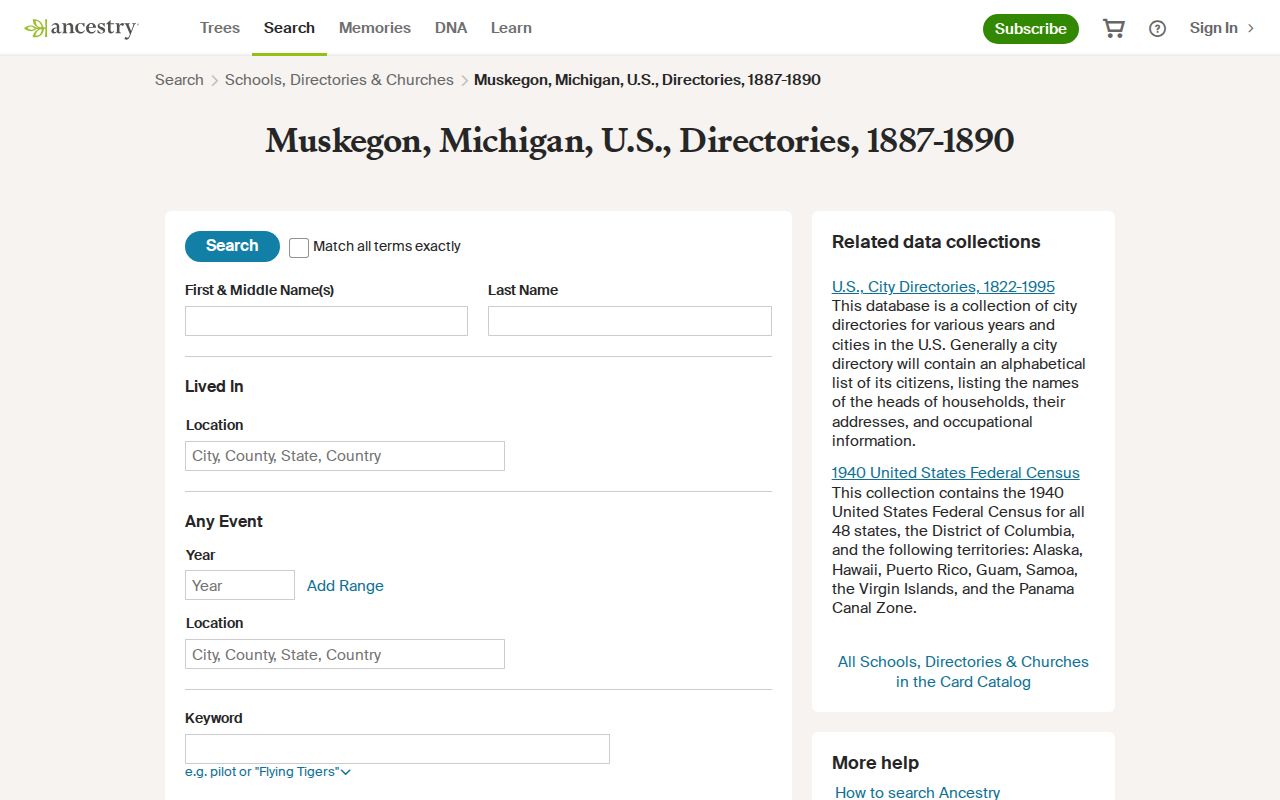
Digital results are most useful when they lead back to the printed entry, its date, and its neighboring listings.